I'm on the road, in search of food — food for my body, food for my mind, food for my soul. I dedicate this blog to peanut butter, my best friend. Food is what we're all about. Cheers!

Saturday, October 29, 2011

What NOT To Eat (Or Drink) On A Macrobiotic Diet


A basic macrobiotic diet is pretty much common sense, actually. Eat good, wholesome, nutritious food that's balanced between yin and yang.
(We need a ratio of 5 yin to 1 yang for a healthy balance.) What we don't need are foods that are too much yin.

Therefore, here's a list of what we don't need
(pages 51-52 of Zen Macrobiotics, by George Ohsawa):

1) No industrialized food or drink — no sugar, no soft drinks, no dyed foods, no non-fertilized eggs, no canned or bottled food.

2) No fruits or vegetables that are artificially produced with chemical fertilizers or insecticides.

3) No foods with preservatives.

4) No vegetable out of season.

5) No extremely yin vegetables — no potatoes, no tomatoes, no eggplant.

6) No spices or chemical seasonings (including commercial Japanese soy sauce and miso that is not made in the traditional, natural way).

7) No coffee, no tea with carcinogen dyes.

8) No chemically produced or treated meat or dairy products.

9) No yeast or baking soda (too yin, rapid-rising, expansive)

Obviously there are times when I'll eat some or more of the items on this list, especially when I'm traveling — however, I try to stick to it whenever I can and definitely when I'm sick or my condition is too yin.

For more information, see the following books, which are available on the George Ohsawa Macrobiotic Foundation website:
Zen Macrobiotics, by George Ohsawa
Essential Guide To Macrobiotics (formerly Pocket Guide To Macrobiotics), by Carl FerreEssential Ohsawa, by George Ohsawa

See also:
What To Eat And Drink On A Macrobiotic Diet
Ten Macrobiotic Diets By George Ohsawa


Related Blog Articles:
The Difference That Eating Healthy Makes
Adapting To The Road
Thursday, October 27, 2011

Ten Macrobiotic Diets By George Ohsawa


Here are ten basic macrobiotic diets suggested by George Ohsawa for your health. (See pages 50-55 in Zen Macrobiotics.)

1) DIET #7100% Cereals (whole grains)

2)
DIET #690% Cereals (whole grains) + 10% Vegetable Nitsuke

3)
DIET #580% Cereals (whole grains) + 20% Vegetable Nitsuke

4)
DIET #470% Cereals (whole grains) + 20% Vegetable Nitsuke + 10% Soup

5)
DIET #360% Cereals (whole grains) + 30% Vegetable Nitsuke + 10% Soup

6)
DIET #250% Cereals (whole grains) + 30% Vegetable Nitsuke + 10% Soup + 10% Animal

7)
DIET #140% Cereals (whole grains) + 30% Vegetable Nitsuke + 10% Soup + 20% Animal

8)
DIET #-130% Cereals (whole grains) + 30% Vegetable Nitsuke + 10% Soup + 20% Animal + 10% Salads and Fruits

9)
DIET #-220% Cereals (whole grains) + 30% Vegetable Nitsuke + 10% Soup + 25% Animal + 10% Salads and Fruits + 5% Dessert

10) DIET #-310% Cereals (whole grains) + 30% Vegetable Nitsuke + 10% Soup + 30% Animal + 15% Salads and Fruits + 5% Dessert

The way I measure out the percentages of my food is by thinking in terms of parts — where ten parts equal 100%, and five parts equal 50% or half. This way, I can use different sized tools to measure proportions for one or more meals.

For example, ten spoonfuls would equal 100%, as would ten cups, ten quarter-cups, or ten teaspoons. I could use ten handfuls for 100% or I could also divide a plate of food into ten equal sections (five on one side and five on the other).

So, if I were to use a 1/4 cup to measure my meal for "Diet #1," I'd have 1 cup of cereal/grains, 3/4 cup of vegetable, 1/4 cup of soup, and 1/2 cup of animal product (except that I'd usually substitute more vegetables instead of animal product!).

By the way, notice how the diet numbers for the first seven diets begin with a positive number and then they change to negative numbers
as you introduce salads, fruits, and dessert to the diet. This applies to two (at least) theorems of the Unique Principle.

See also:
What NOT To Eat (Or Drink) On A Macrobiotic Diet
What To Eat And Drink On A Macrobiotic Diet


Related Blog Articles:
What Is A Macrobiotic Diet, Really? (5/5/2011)
What Is The Macrobiotic Centering Diet? (4/1/2011)
My Notes On The Macrobiotic Centering Diet (4/5/2011)
Diet #7 By George Ohsawa (2/12/2011)
Diet #6 By George Ohsawa (What Is Nitsuke?) (2/27/2011)

Friday, October 14, 2011

Boulder Creek Brewery & Cafe

Recently we went to one of our old favorite restaurants for dinner, the Boulder Creek Brewery and Cafe, in Boulder Creek, California. They have several choices of freshly brewed beer and I've always been partial to any one of their stouts that they are featuring for the day — Black Sheep, Mudslide, Black Dragon, Oatmeal, or El Diablo Imperial Stout.

And because I'm such a lightweight these days when it comes to drinking beer, it pleases me that they offer a small sample-size glass of only a couple of ounces of beer — much more manageable for me! But even so, this time I didn't order any beer since they were sold out of their stout.

Instead, I had one of their "Lomond Burgers" substituted with a grain burger patty instead of meat and served with carmelized onions and gorgonzola cheese. (I don't know why they don't mention this on their web site, but you can substitute a grain burger for any of their beef burger entrees.) Instead of french fries, I had two humongous onion rings (and shared the other two onion rings with my husband). They would have served my grain burger on whole wheat bread but they were all out of that too, so I just ate it plain without the bun. It was really good!

Looking around at the place as I chewed my absolutely delicious food, I thought of how some of the
interior decor could really benefit from some TLC and that reminded me of "Restaurant Impossible" and I wondered how was Hoffman's doing? Here's a link to Hoffman's Bakery Cafe web site, which now gives two followup news articles about the Food Network Makeover they received. (Evidently the reopening dinner was two hours late!) They're thinking that maybe the show will air sometime in January?


Related Blog Articles:
Whole Grains In Restaurants
 
Hoffman's Bakery Cafe

Wednesday, October 5, 2011

Hoffman's Bakery Cafe


Oh boy! I just found out that Robert Irvine is doing a "Restaurant Impossible" mission/t.v. episode on a restaurant here in Santa Cruz and it's going to happen FAST. Like this weekend. Apparently, the restaurant will reopen on next Tuesday. That gives me some food for thought... Here's the news article from the Santa Cruz Sentinel: Food Network's 'Restaurant Impossible' to Remake Hoffman's in Santa Cruz.

I've been to Hoffman's Bakery Cafe before, but that was a long time ago, back when they first opened. I don't remember anything bad about the place, except that they didn't really have any food that I wanted to eat. (Everything was made with white flour, for instance.) And I don't remember it looking that bad — just kinda plain and nondescript. I guess you could say the food and the place altogether was sort of "Blah." Anyway, it quickly became a place that I forgot about.

It will be fun to see what Robert Irvine and the Restaurant Impossible team do to change the place. Here's an online article in wikipedia that tells you all of the restaurants that have been featured in the t.v. show so far: Restaurant Impossible.


Related Blog Articles:
Movies About Food (Monday, January 10, 2011)
Whole Grains In Restaurants (Thursday, March 3, 2011)
Dinner Impossible? (Monday, March 21, 2011)
My Dream Diner (Saturday, May 14, 2011)
Burger Number Seven — Concept For A Unique Restaurant Diner
(Saturday, May 14, 2011)

Thursday, September 8, 2011

The Cheyenne Cafe


We had a nice lunch at the Cheyenne Cafe in the town of Joseph, Oregon before stocking up on food supplies for the cabin we’d be staying in at nearby Wallowa Lake. The service was friendly and the food was good. I had a classic garden burger with onion rings and hot tea. Which got me to thinking all over again about my dream diner and Burger Number Sevens.

We learned from our waiter that there was a rodeo coming up in a couple of days. Joseph holds an annual rodeo that’s really big, called "Chief Joseph Days," but this rodeo coming up was merely a small fund-raiser for the high school. Only local cowboys would be performing and the money was used for college scholarships. Last year they raised enough for three $1,000-dollar scholarships. That’s pretty good!

After lunch, we had a nice walk around town, picked up some brochures at the Information Booth on the sidewalk and some groceries at the local food market, and then headed out to our cabin on Wallowa Lake. The Wallowa Lake State Park web site has a video that illustrates some of the beautiful scenery there.


Related Blog Articles:
Eating On The Road
Adapting To The Road
Ten Recipes To Health And Happiness — Burger Number Seven’s Special Burgers

Tuesday, September 6, 2011

Stockmen’s Restaurant and Lounge


Half-way to Hell and back, or to Hell’s Canyon anyway, in the tiny town of Halfway, Oregon we found a wonderful little Bed & Breakfast place to stay for a night and had dinner a short walk down the road at Stockmen’s Restaurant and Lounge. I’d say it’s more of a bar than it is a restaurant, which made it a rather dark place to hang out. The food was not that memorable, but it was pleasant and it satisfied our needs for the time. (I had a grilled cheese sandwich and plain green salad with no dressing.)

On the other hand, the Pine Valley Lodge was very memorable. For breakfast the next morning, we were served up a buffet of simple breakfast foods in their kitchen, such as granola, yogurt, hard boiled eggs, toast, do-it-yourself waffle iron and batter, and fresh fruit. Coffee, tea, and hot water were also available. This arrangement made it easy for me to make up a bowl of miso broth from my supplies. We carried our food out to the porch and had a nice, leisurely breakfast while looking at all the interesting decorations.

Apparently the lodge was built from many individual houses that had been moved to the site from other locations. The builder then stitched them altogether in the most creative way you can imagine, ending up with a beautiful work of art. Everywhere I turned my head I saw something interesting to look at.

Related Blog Articles:
Eating On The Road
Adapting To The Road

Sunday, August 21, 2011

Breakfast In An Old Hotel


One morning, we walked off the street in downtown Baker City, Oregon into the Geiser Grand Hotel and had a surprisingly good breakfast there.

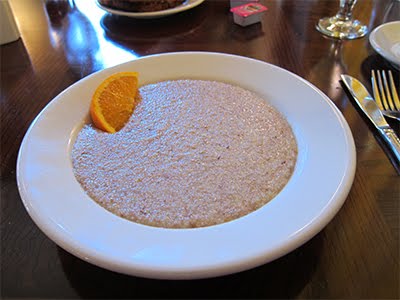
Instead of the “Gluten Free Oatmeal” from Oregon’s Bob’s Red Mill, I decided to try their “Stone Ground Ten Grain” hot cereal instead. Their menu claimed that this was the hot cereal standard of the whole-grain world, made in Oregon with century-old millstones.

The list of ingredients was impressive: high protein hard red wheat, rye, triticale, oat bran, oats, corn, barley, soy beans, brown rice, millet, and flaxseed. And the large bowl of hot cereal that they placed in front of me was also impressive. It tasted good!

The hotel was built 122 years ago in the gold-mining year 1889 by a Czechoslovakian architect named John Benes. It claimed to have the third elevator west of the Mississippi.

After many years of grandeur, the gold mines closed down and the building fell into disrepair. It closed shortly after the cast from the movie “Paint Your Wagon” stayed there in the summer of 1968. Then, during the years 1993 through 1998 the building was completely restored costing six to seven million dollars. Here are links to a case study
done by the National Park Service of Baker City and the rehabilitation of the Geiser Grand Hotel: Baker City page 1, Baker City page 2, Baker City page 3.

Now that I’ve been there and seen the countryside around the Geiser Grand Hotel, I want to watch the movie “Paint Your Wagon” again!

Related Blog Articles:
Eating On The Road
Adapting To The Road